
Fake Google Reviews Exposed: Inside a NYC Dental Network’s 4.8 Rating
It hardly needs explaining how much reviews matter for a business and for a customer. Personally, choosing a service provider always involves checking their reviews on Google Maps.
Anything related to medicine on Google Maps falls into the YMYL (Your Money, Your Life) zone: recommendations that directly affect your money and health. We checked how well Google actually moderates this space — and how honest companies are in one of the most sensitive niches out there: dentistry.
Methodology and Collection Parameters
We picked one of the most competitive dental markets in the world. Data was collected using ReviewStatLab’s algorithms between July 21 and August 17.
- Region New York State (USA)
- Sample 63 dental practices with 400+ reviews
- Total dataset ~56,000 author profiles and over 290,000 reviews
- Collection depth each author’s 10 most recent reviews
Authors were matched by their unique Google profile ID — not name, not photo, the actual ID. Ten recent reviews per author is more than enough to expose clusters, overlaps, and repeat posting patterns. It doesn’t capture an author’s entire history, so if anything, the real scale of what we found below is a floor, not a ceiling.
Overall Result: Most of the Market Plays It Straight
The good news first: the large majority of dental businesses in the sample run honest review profiles built on real patients.
A handful of companies showed minor noise — a few reviews from employees, partners, or relatives tied to one location. Sometimes there’s a boring explanation, like a dentist switching practices and patients following them. None of that moved the needle on a company’s overall rating, so we didn’t bother flagging it individually.
One Company Broke the Pattern Completely
Out of 63 practices, exactly one produced numbers that don’t look like a dental practice — they look like a bought rating. We’ll call it Company A.
At the time of review, Company A had 1,190 reviews and a 4.8 rating. The moment we looked past the headline number and into who was actually posting, the picture fell apart: this wasn’t patient behavior, it was network behavior.
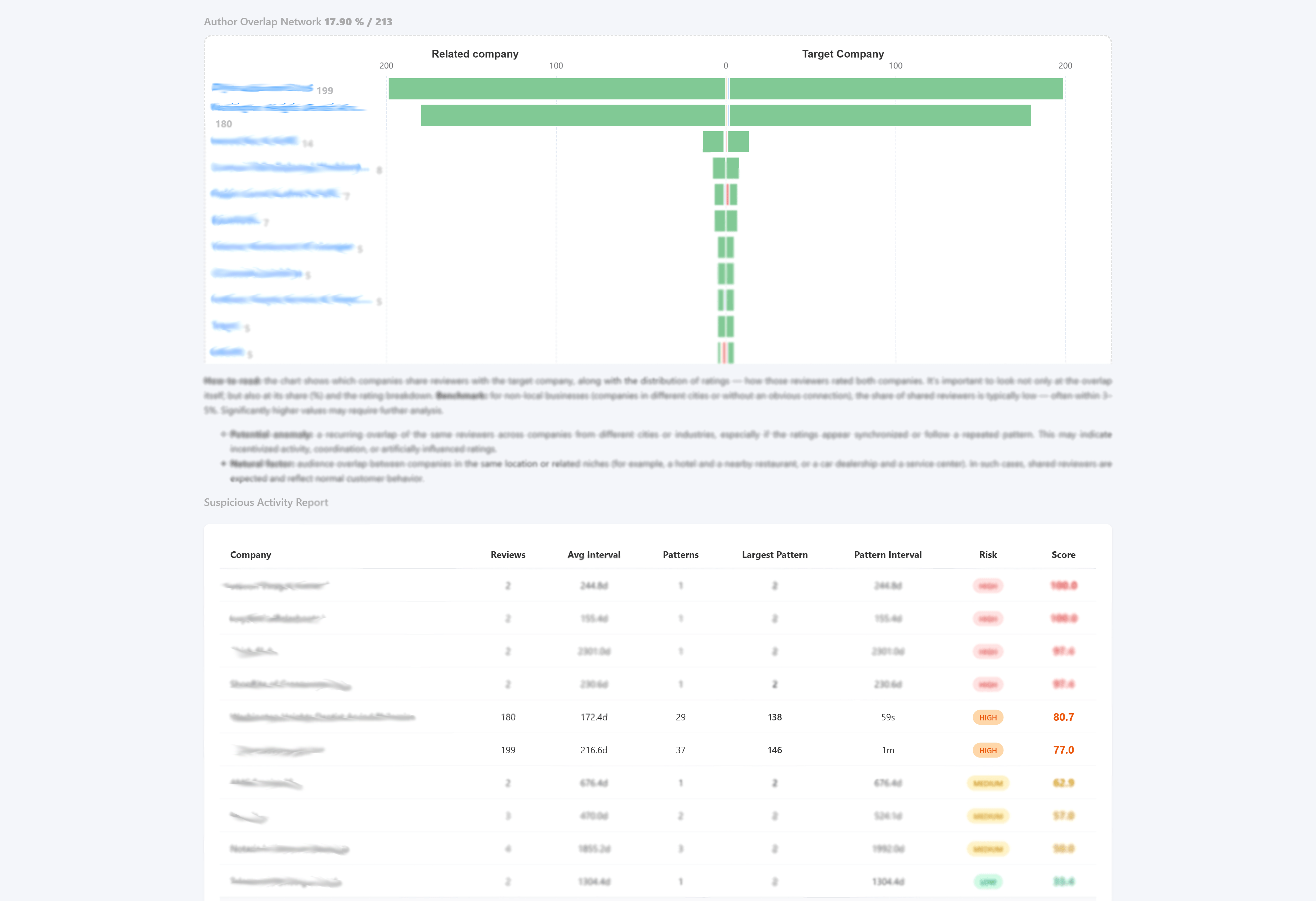
A chunk of the same account pool behind Company A’s reviews also showed up leaving reviews for two other dental practices (Company B and Company C):
- 199 authors of Company A also reviewed Company B.
- 180 authors of Company A also reviewed Company C.
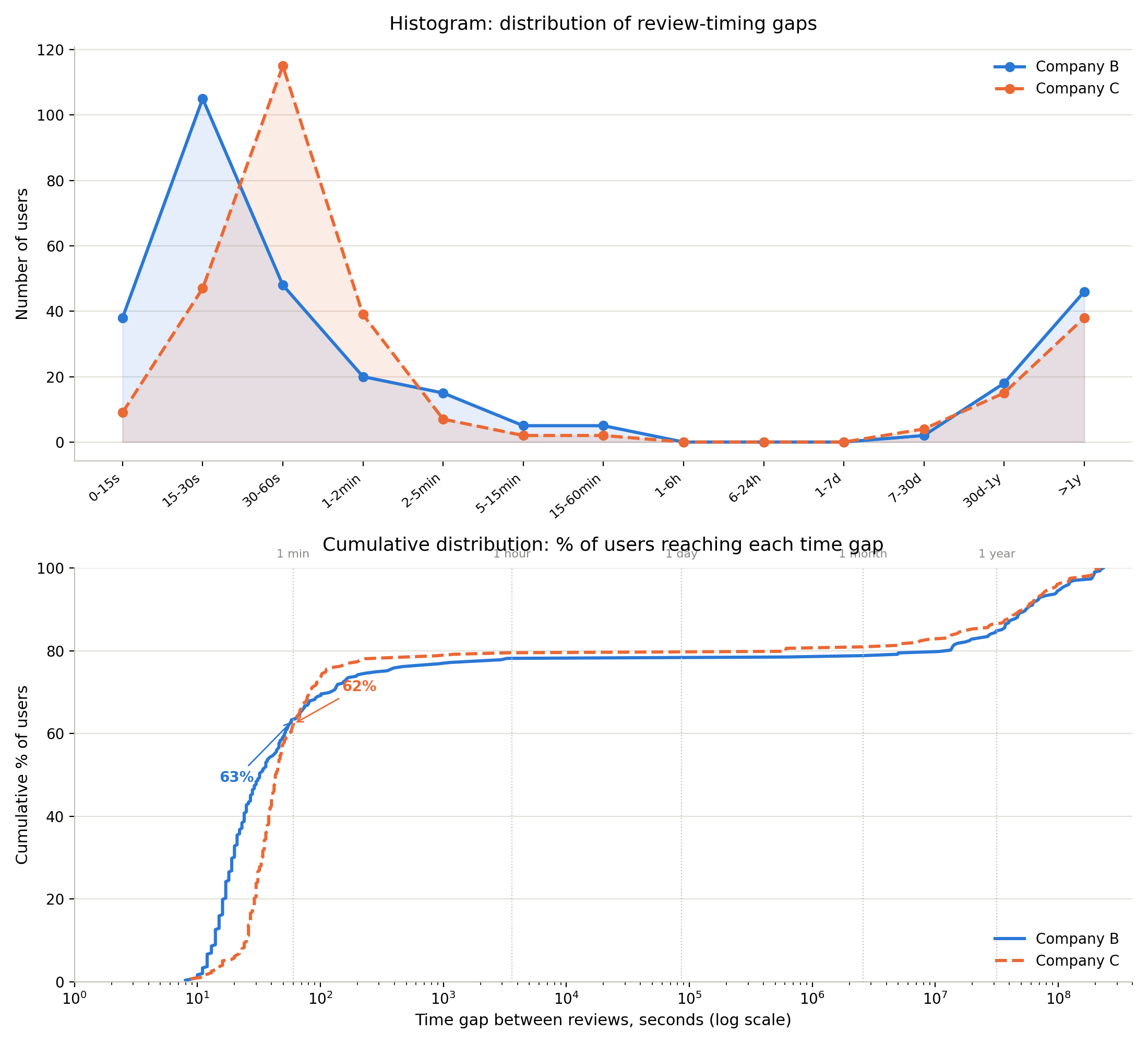
At this stage we didn’t yet know how many of these authors overlapped across all three companies at once. But the overlap alone wasn’t the damning part — the timing was: 75% of these paired reviews were posted less than 1 minute apart. Real patients don’t review two unrelated dental practices back-to-back inside 60 seconds. Scripts do.
The chart below labels this the “largest pattern”: 138 of 180 and 146 of 199 review pairs landed inside that 1-minute window.
Digging Into Companies B and C
The first pass already pointed at manipulation, but private and inaccessible profiles meant we were only seeing part of it. So we flipped the analysis and went straight at the reviewer bases of Companies B and C themselves.
| Company | Initial overlap found (via A) | Full overlap with A | Total reviews | Share of shared authors |
|---|---|---|---|---|
| Company B | 199 | 302 | 346 | 87% |
| Company C | 180 | 278 | 327 | 85% |
Read that table again: 87% of Company B’s reviews and 85% of Company C’s reviews came from the same account network as Company A. These aren’t three independent dental practices with occasional overlap — this is one network wearing three faces. At that share, “organic coincidence” isn’t a serious explanation anymore.
How Much of Company A’s Rating Is Manufactured
Combining the unique profiles from the two related locations gives us a working estimate for Company A’s main profile:
329 profiles out of 1,190 reviewed both Company A and at least one of the two related locations. Of those, 324 gave the maximum 5 stars. Only 5 reviews carried any other score.
This is almost certainly a floor, not the full picture — private profiles we couldn’t trace aren’t in this count. Even at the conservative end, roughly 28% of Company A’s review profile looks manufactured. For a medical practice, that’s not a rounding error — that’s a rating built on a fabricated foundation, and patients are making healthcare decisions based on it.
What Happens Next
We are not naming the companies in this piece. What we found points to a specific network of accounts operating across three business profiles, and that’s the kind of thing that belongs in front of the platform responsible for policing it, not crowdsourced to a comment section.
We’re submitting this dataset — profile IDs, overlap counts, and timing analysis — directly to Google. We’ll follow up publicly once we hear back, whether that’s action taken, no action taken, or silence. If Google’s own review-integrity systems missed a network posting hundreds of near-simultaneous 5-star reviews across three practices for what looks like years, that’s a moderation failure worth tracking regardless of what happens to these three specific accounts.
Key Findings
- Companies B and C aren’t independent dental practices — at 85-87% shared authorship, they function as satellite accounts feeding the same network.
- A substantial share of Company A’s reviews came from a network of accounts shared with two other practices, spanning several years, on a platform where reviews directly influence people’s healthcare decisions.
Thanks for reading this far — this kind of analysis takes real data work, and we built ReviewStatLab specifically to make patterns like this visible instead of buried in 290,000 individual reviews nobody has time to read. If you found this useful, the best way to support the project is to share it and follow for the Google follow-up.
ReviewStatLab is an independent project. Collecting and processing hundreds of thousands of reviews takes time and infrastructure. Support on Patreon funds the Google follow-up and the next analyses in other niches and regions.
Support on Patreon →